Tower Rush game how to play
Tower Rush is a fast game from Galaxsys with a demo mode for testing the rules first. This page explains the basic play flow, the confirmed floor mechanics, and what to check before you use real stakes.
Start with the demo

Open the demo first if you want to see how the game behaves before you place any stake. The demo is available on desktop and mobile, so you can check the flow on the same screen type you plan to use later. In a mobile session, the main benefit is simple: you can read the on-screen prompts and follow each round without committing any money.
Use the demo to watch one complete round from start to finish. That gives you a clear view of how floor placement, the multiplier display, and the cashout moment are shown on the interface. If you are new to this format, the demo is the safest place to learn the sequence because it lets you pause, observe, and repeat a round as many times as you need.
| Demo option | What you can do with it |
|---|---|
| Desktop demo | Read the full interface and follow the round flow on a larger screen. |
| Mobile demo | Check the same round flow on a phone or tablet before you decide to play with a stake. |
If you plan to use the app later, the demo is still the best first step. It lets you confirm where the rules are shown and how the game communicates each action without forcing you to guess from the title alone.
Read the controls and rules
The confirmed core rule is direct: players stack floors while avoiding collapse. Each successfully placed floor adds a multiplier, and the game multiplies those values together. If you cash out, the payout is the stake multiplied by the accumulated multiplier. That is the full supported play loop, so focus on those three points when you read the rules panel.
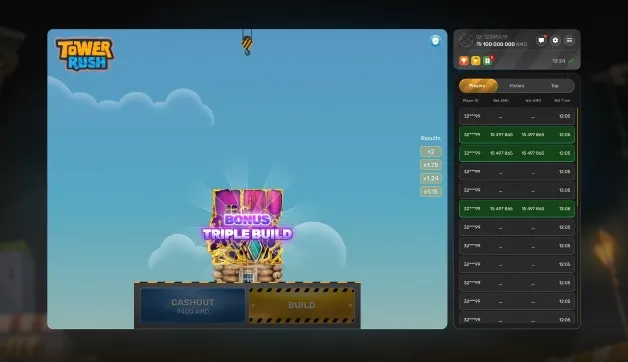
In practice, this means you need to watch two things at the same time: whether the next floor is placed successfully, and what the current accumulated multiplier shows. The game does not require you to assume extra features beyond that. If the rules screen lists the bonus floors, note their names exactly as shown: Frozen Floor, Temple Floor, and Triple Build. Those are named floor types, so treat them as part of the game’s visible structure rather than as a general promise about outcomes.
Here is a simple way to read one round:
- Check the stake you want to use for the round.
- Start a round and follow the floor placements shown on screen.
- Look at the multiplier after each successful placement.
- Decide whether to continue the round or cash out based on the current display.
- If you cash out, confirm that the payout uses the stake and the accumulated multiplier.
| Supported element | How to read it |
|---|---|
| Floor placement | Each successful placement adds to the running multiplier chain. |
| Cashout | The game pays the stake multiplied by the accumulated multiplier shown at that moment. |
A worked example is possible because the multiplier mechanic is explicit. If you place one floor successfully and the current multiplier becomes 2x, then a 100 stake would cash out at 200 if you stop there. If a later successful placement increases the accumulated multiplier to 3x, the same 100 stake would cash out at 300. This example follows the supported rule that the multipliers are multiplied together, so the displayed total is the figure that matters at cashout.
Keep the bonus floor names in mind when you are reading the interface, but do not assume extra effects unless they are shown in the game rules. The most useful habit is to match every on-screen label with the rule text, especially when you see a new floor type for the first time. That approach helps you understand the game without filling in any missing mechanics from guesswork.
Before using real stakes
Before you move from the demo to a real stake, make sure you understand the difference between a stake and an account deposit. A stake is the amount used in a round, while a deposit is money added to your account balance. The game rules speak about the stake in the payout formula, so do not confuse the two terms when you plan a session.
Check the RTP range before you decide to play with real stakes. The listed range is 96.2% to 97.6%, which describes the game’s return profile and not a guaranteed return for any one player. Use that number as a reference point only. It does not tell you what will happen in a single round, and it should not be treated as a promise of a result.
If you want a practical pre-play routine, use this order:
- Open the demo and read the in-game rules once more.
- Confirm the stack-and-cashout flow on the screen.
- Review the RTP range and the floor names if they are visible in the rules panel.
- Decide on a stake that you are comfortable using for a short session.
- Only then move to a real-stake round.
One useful way to think about the game is to treat each round as a separate decision point. The multiplier grows only when a floor is placed successfully, and the cashout value follows the current accumulated total. That makes the current display more important than the title of the game or any outside description. If you see the app version on your device, the same basic rule reading still applies: check the interface, confirm the current round state, and use the displayed multiplier before you commit a stake.
For a reader in Pakistan, the most practical habit is to search the operator’s own catalogue for the game name and then open the listing that shows the demo or the rules panel. If the casino offers a search tool, use it to locate the game directly rather than relying on category pages alone. That lets you verify the round flow and the named floor types in the place where you plan to play.
How do I start learning the game?
Open the demo first and follow one full round from the start screen to the cashout display. That gives you a safe view of the floor placement flow, the multiplier updates, and the rule panel without using a stake.
What is the main rule I should remember?
The key rule is that players stack floors while avoiding collapse. Every successful floor placement adds a multiplier, and the multipliers are multiplied together before cashout.
How does cashout work here?
If you cash out, the payout equals the stake multiplied by the accumulated multiplier. The amount depends on the current displayed total at the moment you stop.
What are the bonus floors called?
The named bonus floors are Frozen Floor, Temple Floor, and Triple Build. Read their names in the rules panel and match them with the on-screen labels during play.
Is the demo available on mobile?
Yes. The demo is available on mobile, so you can read the rules and watch the round flow on a phone or tablet before you decide to use real stakes.
Ready to Play Tower Rush?
Try the demo or play at Mostbet Pakistan with local payment methods.