Tower Rush Game Mechanics and Features
Tower Rush is a fast game from Galaxsys with a stack-and-multiply structure. This page explains the confirmed mechanics, the named bonus floors, and the mobile and demo options that are directly stated for the game.
Game Mechanics and Features format and core rules

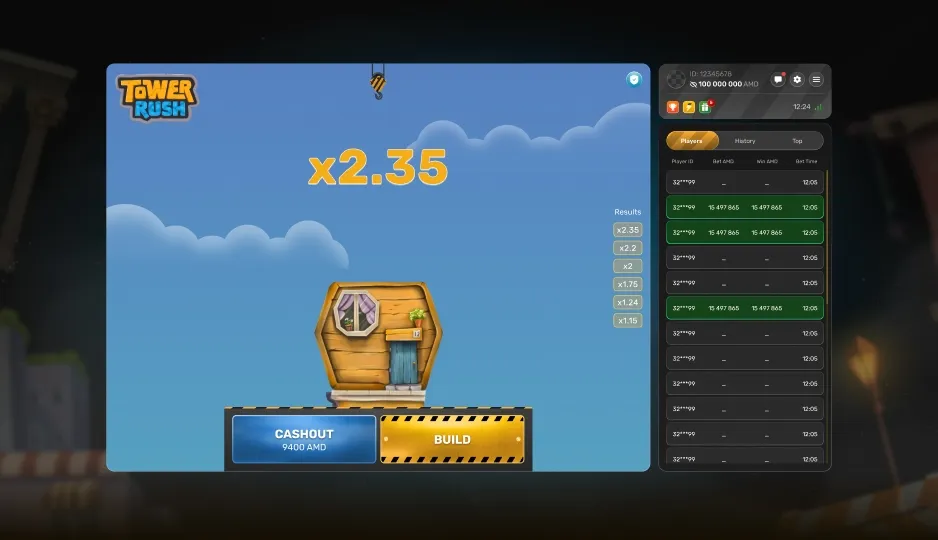
The game belongs to Galaxsys’ Fast / Turbo Games category, which points to a quick session style rather than a slow build. The main action is simple to describe: players stack floors while avoiding collapse. Every floor that lands successfully adds a multiplier, and those multipliers are multiplied together. That means the result depends on how many floors are placed before the stack fails.
When a player cashes out, the payout is the stake multiplied by the accumulated multiplier. The stake is the amount placed into the round; it is not the same thing as a deposit into an account. In practice, the mechanics reward careful timing within the round itself, because the stack can end if it collapses before the player leaves.
| Mechanic | What it means in play |
|---|---|
| Stacking floors | The player adds floors one by one during the round. |
| Successful placement | Each safe floor adds a multiplier that contributes to the final result. |
| Collapse risk | The stack can fail, so the round does not continue forever. |
| Cashing out | The round ends with the stake multiplied by the accumulated multiplier. |
The structure is straightforward, but the order matters. The player is not building for decoration; each placed floor affects the final outcome through the multiplier chain. Because of that, the round is best read as a sequence of decisions rather than a static screen.
Game Mechanics and Features risk, pace, and session planning
Fast / Turbo Games are built around speed, and this one fits that pace through short decisions and immediate round resolution. The confirmed mechanics do not describe a separate bonus buy, free spin mode, or fixed round path. What is confirmed is the tension between continuing to stack and leaving with the current accumulated result.
Session planning therefore starts with the stake. Since the cashout amount is calculated from the stake and the accumulated multiplier, the player should decide the round size before starting, not after the stack has already grown. A smaller stake keeps the round contained; a larger stake increases the value of the same multiplier outcome. The mechanics do not promise any outcome, so the practical choice is about managing the round size, not chasing a guaranteed result.
Two simple examples show the difference. If a player places a modest stake and exits after a few safe floors, the final amount reflects that small base. If another player uses a higher stake and reaches the same multiplier level, the payout is larger because the stake is larger. The multiplier system changes the scale of the result, but it does not change the fact that the base amount remains the player’s own stake.
| Planning point | Practical reading |
|---|---|
| Round pace | Decisions happen quickly, so the player should be ready before starting. |
| Stake size | The stake determines the base amount used in cashout math. |
| Exit timing | Leaving before collapse preserves the current accumulated multiplier. |
| Longer stack | More successful floors increase the multiplier chain, but only while the stack stays intact. |
One named release detail helps place the game in context: it launched on 2024-02-28. The RTP range is stated as 96.2%–97.6%, but RTP is a long-run percentage measure, not a promise for any single session. A player should read that figure as game information, not as a guaranteed return on an individual round.
How Game Mechanics and Features works on mobile
Mobile access is confirmed in two ways: a demo exists, and a mobile demo also exists. That makes it possible to test the stack-and-multiply flow on a phone before playing in a live mode. The confirmed app availability also means the game is not limited to desktop use.
On a smaller screen, the most useful approach is to keep attention on the current stack state and the cashout moment. The mechanics are simple enough that the player does not need a long control guide, but screen size still affects readability. Mobile play is therefore most useful when the player wants a short session and an immediate understanding of the current round rather than a large-screen layout.
The game is categorized as fast, so mobile use matches the intended pace. A player can open the demo on mobile to understand how the floor stack behaves, then switch to the app if they want to continue on the same device. The confirmed mobile demo is especially practical for learning the action without pressure on the first attempt.
- Use the mobile demo to see how each successful floor changes the multiplier chain.
- Check the current stake before starting, since cashout uses that amount in the final formula.
- Keep the screen clear of distractions when the stack is moving quickly.
- Use a short first session to understand the pace before making longer round decisions.
Game Mechanics and Features bonus and balance checks
The confirmed bonus floors are Frozen Floor, Temple Floor, and Triple Build. These are named features of the game, so they should be read as specific in-game elements rather than as casino promotions. No separate bonus amount is stated, and nothing in the facts suggests a free-spins structure or a deposit offer.
A balance check in this game is best understood as a player action before and after a round. Before starting, the player checks whether the chosen stake fits the session. After cashout or collapse, the player checks the remaining balance and decides whether to continue with the same size or adjust. The mechanics themselves do not change the account balance; they only determine the round result.
Because the multiplier is accumulated during the stack, the bonus floors matter as named features, not as a guarantee of stronger results. The player can treat them as part of the round’s structure and watch how they fit into the flow of floor placement. That is more useful than expecting them to act like an external promotion.
Named bonus floors at a glance
| Bonus floor | Confirmed role in the game |
|---|---|
| Frozen Floor | One of the named bonus floors in the game. |
| Temple Floor | One of the named bonus floors in the game. |
| Triple Build | One of the named bonus floors in the game. |
For players in PK who want to check the game on a casino site, the practical step is to search the operator’s own catalogue for the title rather than assume every lobbied collection includes it. A confirmed casino note exists for Mostbet in Pakistan, but that does not change the game mechanics themselves. The core play remains the same: stack floors, watch the multiplier chain, and cash out if the round is still intact.
Common Game Mechanics and Features mistakes
The most common mistake is treating the round like a fixed-result feature. The confirmed mechanics do not support that idea. Each floor must be successfully placed, and collapse is part of the structure. A player who ignores that tension may hold too long or exit without understanding how the multiplier was built.
Another mistake is confusing the stake with a deposit. The stake is the amount used inside the round. A deposit is an account funding action, which is separate from the in-round calculation. When the player reads the cashout formula correctly, it becomes easier to manage the round without mixing account money with round-level results.
A third error is reading RTP as a guaranteed return. The stated RTP range gives a long-term context for the game, but it does not promise what a single session will pay. The same point applies to the bonus floors: they are named features, not a promise of a better outcome every time they appear.
- Do not assume a round will continue just because the previous floor landed safely.
- Do not use account deposit language when you only mean the stake for one round.
- Do not read RTP as a personal guarantee for the next session.
- Do not confuse the bonus floors with casino-side promotions.
What is the core mechanic in Tower Rush?
The core mechanic is floor stacking. Players place floors one by one, and each successful placement adds to a multiplier chain. If they cash out, the stake is multiplied by the accumulated multiplier.
Does the game describe separate bonus rounds?
No separate bonus-round structure is confirmed. The named features are Frozen Floor, Temple Floor, and Triple Build, which are described as bonus floors rather than as outside promotions or free-spin style events.
Can I try the game before using the app?
Yes. A demo is available, and a mobile demo is also available. That lets a player try the stack-and-multiply flow on a phone before using the app version.
What should I check before starting a session?
Check the stake size, because cashout depends on it, and make sure you understand that a collapse can end the stack before you leave. It is also useful to confirm whether you are in the demo or the app, since the game is available in both forms.
Is Tower Rush the same as a crash game with cashout rules from other titles?
No extra crash-game rules are confirmed here. The only supported mechanic is floor stacking with accumulated multipliers and cashout based on the stake multiplied by that accumulation.
Ready to Play Tower Rush?
Try the demo or play at Mostbet Pakistan with local payment methods.